
My writing process has always started with drawing; I find the medium much more suited to make sense of that first onslaught of ideas and visuals in your mind. The Fine Arts were my first art, but just like my stories I mostly kept them to myself until recently. So it was a major propellor in my first year of publishing when my father and his partner asked me to design the cover for their political science book The Antigonistic Conflict: Antigone today and Democratic Self-Conception (Title translated from German.) If you ever wanted to know what thought processes and dialogues lurk behind the curtain of a finished book cover, this article is for you.
Looking for Antigone
For those that are unfamiliar: Antigone is an ancient Greek theatre play by famous tragedian Sophocles and gave us one of the most intellectually influential heroines of all times:
The Play
Brothers Eteocles and Polynices die fighting each other for the throne of Thebes. Creon, the new ruler of Thebes and their uncle, has decided that Eteocles will be honored and Polynices will be denied the holy right of a burial. But their sister Antigone defies Creon and secretly buries Polynices herself.
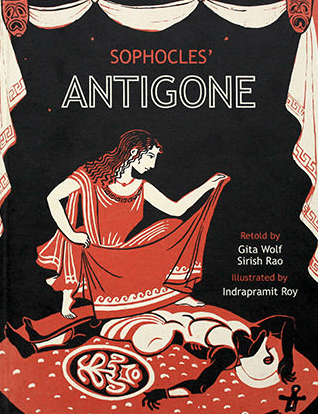
Antigone’s legendary defiance is often evoked when discussing Civil Disobedience, the right of the individual to reject society’s infringement on one’s freedom to perform a personal obligation. This juxtaposition of obligations – the law versus individual ethics – is the central theme of both the play and this book and one of significant contemporary importance. Be it Ukrainian men fleeing their country and defying conscription law or whistleblowers betraying their country’s military secrets out of morality: civil disobedience is one of the most heated and polarizing discourses of our time.
So how do you evoke all that in just one image within the minimal design mandate of an academic publisher?
The Inspiration
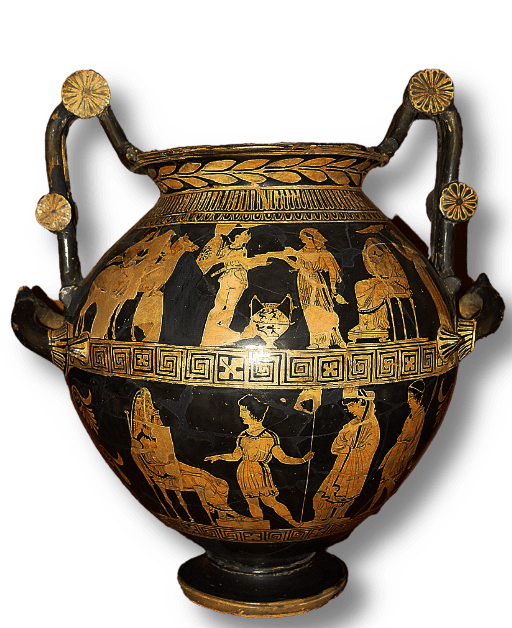
The authors wanted me to use the classic and timeless Greek vase style in black-orange, and to base my painting on one of the few antique depictions of Antigone, for recognition value. However, while there is an abundance of Hercules vases, there is but a single vase we think might depict Antigone before Creon as she is judged. Personally, I believe that might be because contemporary men feared an empowered woman challeninging the system just as much as some people still do today. Whatever the reason, this is the image I had to go on:
Reimagining & Collaboration
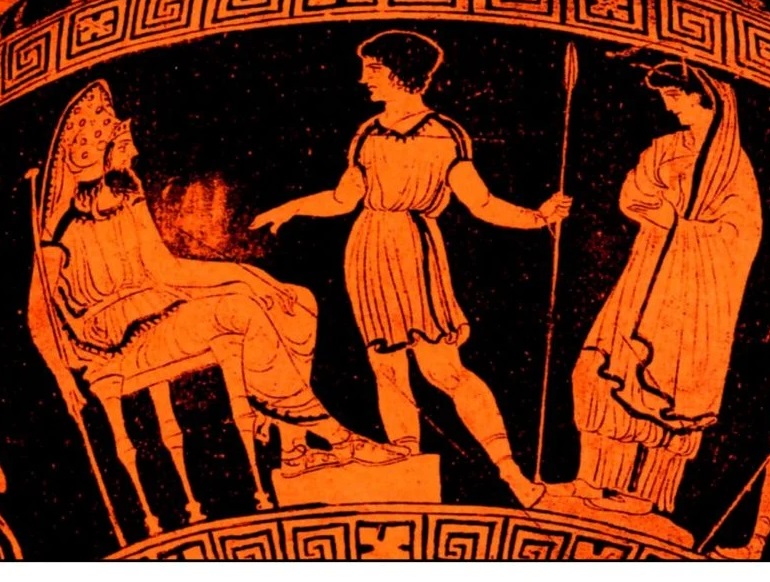
My instructions were: cut the middle guy out and redraw Creon and Antigone with a crack dividing the two. But I had a few other modifications in mind:
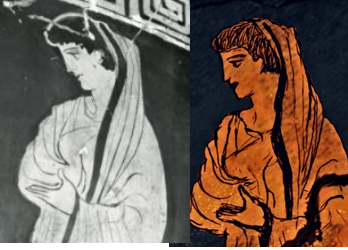
In the original Antigone is demure. My rendition is more truthful to her character: head held high and proud. I did that without consultation and got a “We know what you did there” but they loved it.
Final Result: The Polynices Divide
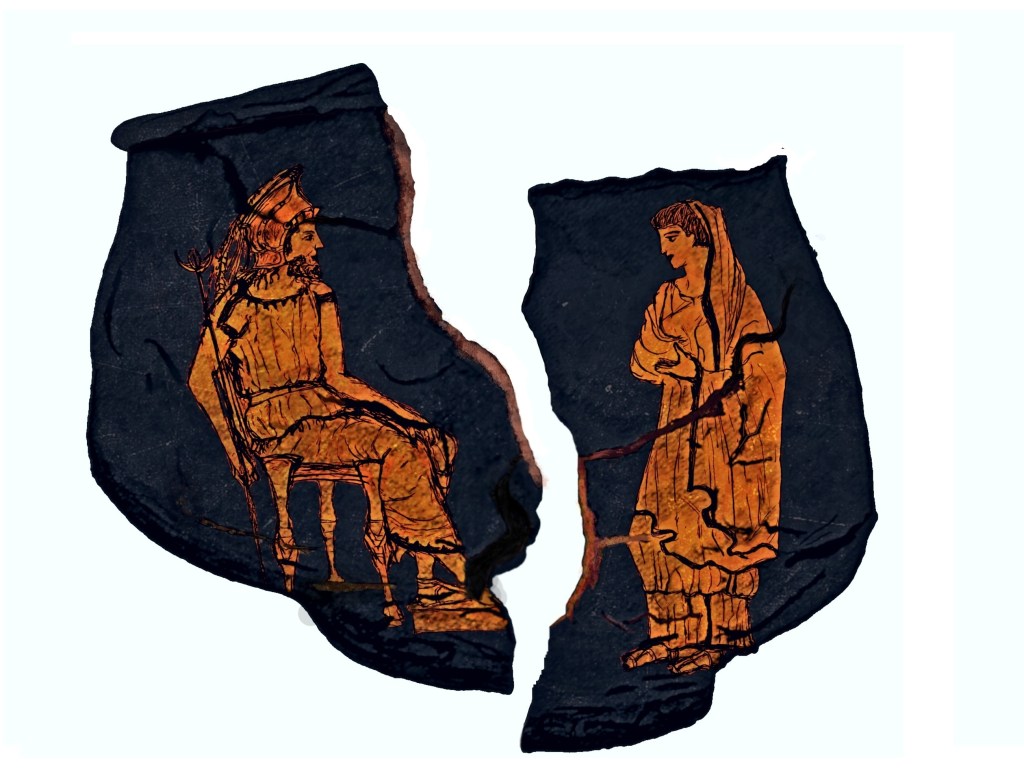
My ultimate idea was to have the simple split become actual vase shards, both Creon and Antigone torn apart and consumed by the contradicting forces of power meeting in them. To underscore that point, I made the cracks appear as molten lava.

And this is the final book! Simple, but crammed with both ancient and recent history. I hope this elaboration on a book cover process can be of some help if you’re thinking of designing your own or hiring an artist. One thing’s for sure: give it a lot of thought and learn your history.
Subscribe for more posts like this

 Roxane Llanque
Leave a comment